


If you’re trying to monetize your expertise, you’ve probably asked yourself: Should I build a course or a membership?
At first glance, they look almost similar.
- Both allow you to sell knowledge.
- Both help you build authority.
- Both can generate income online.
But once you look a little closer, the differences start to matter. And choosing the wrong model can limit your revenue, increase churn, and slow down your growth.
The right model, on the other hand, can mean:
- More predictable income
- Better engagement
- Lower churn
- Higher long-term growth
Many creators launch an online course when they actually need a membership site. Others start a membership without realizing their audience only wants a one-time structured program.
So the real question is:
Online course vs membership site – which one is right for your business?
In this article, we’ll discuss the membership site vs online course differences, revenue models, advantages, and use cases. By the end, you’ll know exactly which model fits your goals, or whether combining both is the smartest move.
TL;DR: Online courses are structured one-time programs. Membership sites offer ongoing content with recurring payments. For both models in one place, ARMember lets you run courses and memberships together on WordPress.
What Is an Online Course?

An online course is a structured digital learning program to teach a specific skill or topic from start to finish.
Simply put, an online course is any web-based class that can be viewed on a computer, tablet and smart phone.
Think of it like a digital classroom, but without walls.
It usually includes video lessons, downloadable materials, quizzes, assignments or certificates. Learners enroll, go through the modules step-by-step, and complete the course at their own pace.
Unlike a membership site that runs continuously, an online course typically has a clear beginning and end.
For example:
- A “Complete WordPress for Beginners” program
- A “30-Day Fitness Transformation Course”
- A “Digital Marketing Masterclass”
Once users buy the course, they get access to the complete curriculum (or sometimes released in stages). In most cases, it’s just a one time payment.
Key Characteristics of an Online Course
To choose the right model, you must first understand how an online course is fundamentally designed to function.
- Structured Curriculum: Online lessons are arranged in modules or chapters. Plus, each step builds on the previous one. Thus students get a clear learning path from beginner to advanced.
- Defined Outcome: Every course promises a result. It could be about learning graphic design, building a website and so on.
- One-Time Purchase Model: Most online courses are sold for a single payment so users pay once and get lifetime or long term access. This makes it attractive for buyers who prefer “pay once, own forever.
- Limited Ongoing Updates: Once created, many courses remain static. You can update lessons occasionally, but it doesn’t need continuous weekly content creation like a membership site. (That’s why online courses are often called scalable digital products.)
- Self-Paced Learning: Students can start and complete the course anytime. There’s no pressure to keep up with monthly content.
When an Online Course Works Best
Now comes the practical question.
When should you choose an online course instead of a membership site?
An online course works best when:
- You teach a clear skill or transformation.
- Your audience wants a structured roadmap.
- You prefer a one time sale model.
- You want higher upfront pricing.
- You’re just getting started.
What Is a Membership Site?

A membership site is an gated online platform where users pay a recurring fee, monthly or yearly, to get the access of premium content, resources or community benefits.
Simply put, a membership site is a place where people sign up to get access to members-only perks.
Think of it like an exclusive club, just digital.
A membership site is continuous with no clear finish line. After all, why should it? Because that’s exactly what makes membership sites different from online courses.
- A fitness membership with new workout plans added every week.
- A business community with live Q&A sessions each month.
- A stock photo library updated regularly.
- A premium newsletter with exclusive insights.
These are all examples of membership sites with ongoing value.
In simple words, a membership site focuses on ongoing value rather than one-time transformation.
Key Characteristics of a Membership Site
Here’s what a membership site is actually made of and include(That Courses Don’t):
- Recurring Subscription Model: This is the biggest difference. Members pay monthly, quarterly or yearly to maintain access,. giving you a more predictable recurring revenue. But it also needs consistent value delivery to lower cancellations.
- Continuous Content or Benefits: A membership site isn’t static. You regularly have to add new lessons, live sessions, digital downloads, and so on to keep moving on. No new values = No members = No revenue.
- Community Engagement: Many membership sites have private groups or forums so members can interact with each other. Thus, for someone, the community itself becomes a big reason to stay subscribed.
- Flexible Content Structure: Members can explore different topics based on their interest rather than just following a fixed curriculum like online courses.
- Long Term Relationship: A membership site must maintain long term connections. The longer members stay, the more stable your revenue becomes.
When a Membership Site Works Best
A membership website works the BEST when:
- Your content needs ongoing updates.
- You want predictable recurring revenue.
- You thrive on community and interaction.
- Your audience needs continuous support.
- You’re building a brand ecosystem.
Online Course vs Membership Site: Quick Comparison
Now that you understand both models individually, let’s put them side by side.
At first look, an online course and a membership site still look similar.
- Both sell digital content.
- Both can scale.
- Both can be hosted on a powerful membership site platform or online course platform.
However, when you look closely, the difference becomes clear.
Here’s a quick comparison to help you understand online course vs membership site in a simple way:
| Feature | Online Course | Membership Site |
| Core Purpose | Deliver a specific transformation. | Provide ongoing value & access. |
| Content Structure | Structured modules with a clear start and finish. | Flexible, continuous content. |
| Revenue Model | One-time payment. | Recurring subscription (monthly/yearly). |
| Income Predictability | Depends on new launches or sales. | More predictable. |
| Content Updates | Occasional updates. | Regular ongoing updates. |
| User Commitment | Complete the course and move on. | Stay subscribed for continued access. |
| Engagement Style | Mostly self-paced learning. | Community-driven & interactive. |
| Pricing Model | Higher upfront pricing. | Lower entry price, long-term revenue. |
| Best For | Skill-based learning. | Long-term support & community. |
In Simple Terms…
- An online course is like buying a complete book. You read it, learn from it and finish it.
- A membership site is like subscribing to a magazine. You keep receiving fresh issues as long as you stay subscribed.
Both models work. The right choice depends on your goals.
- If you want structured learning with a clear outcome, pick an online course.
- If you want recurring income with ongoing engagement, go for a membership site.
But what about revenue potential? Which model actually makes more money in the long run? Time to check it out.
Revenue Model Breakdown: Which Makes More Money?

Now comes the big question,”When comparing online courses vs membership sites, which one actually makes more money?”
The honest answer? It depends on your strategy.
An online course can generate large upfront revenue. A membership site, on the other hand, can generate steady and predictable income.
So let’s understand both with simple numbers.
One-Time Sales Model (Online Course)

An online course mostly works on a single payment model. Customers pay once. They get access. That’s it.
This model is powerful if:
- You price your course higher (for example $197, $297 or $497).
- You have strong marketing launches.
- Your course delivers a clear transformation.
The advantage?
You can make big revenue in a short time especially during launches.
The downside?
Income depends on continuous promotion. If you stop selling, revenue slows down. And that creates a cycle most course creators don’t expect.
Let’s say:
- Your online course price = $297.
- You sell to 100 students
- Revenue =
- $297 × 100 = $29,700
That’s impressive for a single launch.
But next month?
There’s no recurring revenue unless you keep selling. And that’s the real trade-off of the one-time sales model:
High revenue bursts, but low revenue stability.
Recurring Subscription Model (Membership Site)

Now let’s look at the membership site model – The recurring subscription model.
Here, you don’t charge higher one-time fees like online courses. You charge small recurring amount at specific time intervals such as
- $29 per month.
- $49 per month.
- $99 per month (depending on value).
The power of this model lies in retention.
Even if you stop aggressive membership marketing for a while, existing members continue paying. Of course, as long as they see value.
This creates predictable monthly recurring revenue (MRR). On top of it, you aren’t limited to monthly revenue only. You can charge recurring fees per year as well as quarterly.
And once you understand how this compounds, the membership model becomes even more powerful.
Let’s assume:
- Membership price = $39 per month
- You get 100 members
- Monthly Revenue =
- $39 × 100 = $3,900 per month
Now let’s extend that:
If those members stay for 12 months:
- $3,900 × 12 = $46,800 annually
- And that’s from just 100 members.
Now imagine growing to 300 or 500 members.
That’s where membership sites become powerful.
Which Model Is Easier to Launch for Beginners?

Online courses are easier to launch for most beginners because you only need to focus on one clear outcome. Plus, it’s simpler to start compared to a membership site.
For creating your own online course, you:
- Pick a specific problem.
- Create structured lessons.
- Record your content.
- Launch and sell.
Once it’s ready, you don’t need to constantly create new content every week.
Best of all, there’s no pressure of ongoing updates.
That makes it easier to manage, especially if you’re working solo.
A membership site, on the other hand, demands consistency for consistent revenue. You must:
- Add new fresh content regularly.
- Keep members engaged.
- Lower churn.
- Possibly manage community discussions.
It’s not just about launching, but maintaining. And for beginners, that continuous responsibility can feel overwhelming. If you stop delivering value, members cancel. And recurring revenue drops.
Another important factor is authority.
If you’re new and still building confidence, creating one focused course sounds more manageable than promising ongoing monthly content.
Membership sites work better when:
- You already have an audience.
- You can consistently create content.
- You’re comfortable engaging with members long term.
In simple terms, an online course is easier to build and a membership site is harder to maintain.
But remember, easier doesn’t always mean more profitable. The right choice depends on your long term vision. And what if you don’t want to choose just one?
Let’s explore how combining both models can be the smartest strategy.
Can You Combine an Online Course and a Membership Site?

Yes, of course! And in many scenarios, it’s the smartest strategy.
When comparing online courses vs membership sites, you don’t always have to pick one over the other.
In fact many successful businesses use both models to increase revenue and retention.
Think of it like this:
- An online course gives a clear transformation.
- A membership site gives ongoing support and value.
An online course gives a clear transformation.
A membership site gives ongoing support and value.
When you combine them strategically, you get the best of both worlds. Let’s see how.
Course → Membership Funnel
This is one of the most powerful models, and here’s how it works:
You sell a structured online course (one time payment). And when students complete the course, you invite them to join your membership site for continued support.
For example:
A “Launch Your Website” course which is followed by a membership for ongoing marketing tips, updates and community support.
The course solves the main problem. The membership helps them grow further.
Why this works:
- Students already trust you.
- They’ve seen results.
- They’re more likely to stay long term.
This increases the lifetime customer value of your program.
Membership → Premium Course Upsell
Now let’s flip it.
In this model, people join your membership at a lower monthly or yearly fees. They consume regular content and then, you offer a premium structured course as an upsell.
Members join for ongoing value, and once they trust your expertise, you offer in depth premium courses for a one time fee.
For example:
- $29/month membership for general business tips.
- $399 premium “Advanced Scaling Masterclass” course.
Members are already engaged and paying. Thus when you offer a high ticket course, conversion rates are usually higher.
Why?
Because they already believe in your expertise. This approach works especially well if your membership site has more community engagement.
That’s why, stop asking:
“Online course vs membership site: which one should I choose?”
You can ask:
“How can I strategically combine both?”
Because in today’s digital business world, hybrid models often win.
Best Platform for Online Courses and Membership Sites – ARMember
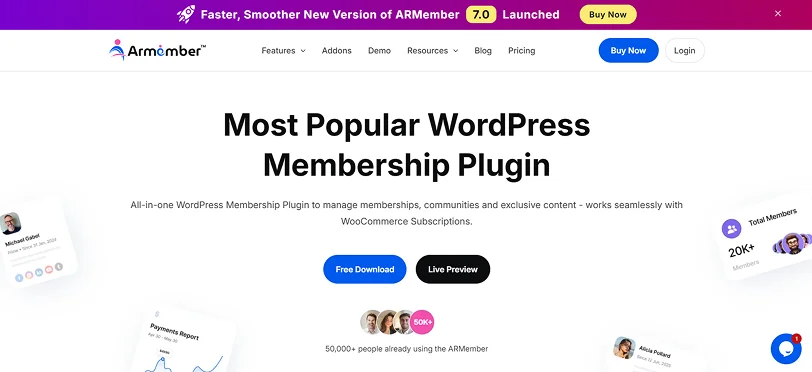
ARMember is a smart choice when you need one platform to handle online courses and memberships together. It is a powerful WordPress membership plugin with a rich ecosystem of over 57+ in-built addons.
The best part? ARMember is an all-in-one membership site + online course builder. It never forces you to pick one model. You can either go with an online course, membership site or both at once. It lets you:
- Sell one time online courses.
- Charge recurring subscriptions.
- Create unlimited tiered membership levels.
- Offer hybrid funnels (membership → course).
- Restrict content based on plans.
- Drip content over time.
This WordPress LMS plugin lets you create and sell online courses using its Online Courses Addon. You create lessons in audio, video and text formats, and quizzes. Later, you can also reveal lessons of courses in the exact way you want with drip content rules.
And once a course is done, ARMember automatically generates Certificates for course completion.
Don’t box yourself into any one model today and wish you hadn’t later. ARMember gives you the freedom to experiment and grow.
Final Thoughts
So when it comes to online courses vs membership sites, which one wins?
The truth is there’s no universal winner. Only the right model that fits your goals.
If you want to deliver a structured transformation with a clear end result, go with an online course. And if you want recurring revenue and ongoing engagement, a membership site is the better option.
And if you want maximum growth? Combine both.
Start with one strong offer. Validate your audience. Then expand into a hybrid model with ARMember.
Related Articles:
- Launch Online Course the Right Way: Free Checklist
- How to Build a Membership Website with WordPress?
- What is a Membership Plugin? Everything You Need to Know
FAQs
Is a membership site the same as an online course?
No, a membership site is not the same as an online course. An online course is a structured one-time purchase with clear start and end, whereas a membership site is an on-going subscription based model.
What is the difference between a course and a membership?
A course is a step by step learning program with a structured roadmap and one time payment. On the flip side, a membership site offers ongoing value, community engagement, flexible content access and recurring revenue. In a nutshell, courses have a clear endpoint while memberships continue as long as the user subscribes.
What platform is best for building a membership site or online course?
ARMember is the best platform for creating your own membership site or online course. It is an all-in-one WordPress membership plugin that allows you to create unlimited membership levels and online courses.
What are the disadvantages of online courses?
While online courses generate great upfront revenue, they fully depend on marketing and new launches. Once the course is complete and sold, income can slow down. Further, courses mostly need occasional updates rather than continuous engagement which limits long term recurring revenue.
Can a membership site include online courses?
Yes, a membership site can include online courses as a part of its content offering.
Can you turn an online course into a membership website?
Yes, with ease! You can turn an online course into a membership site by offering your course first and then inviting students to join a membership site for ongoing support, updates, or community access.

Share this post


